
On the muggy afternoon of August 2, 1876, in the lawless gold-rush gulch of Deadwood, Dakota Territory, James Butler “Wild Bill” Hickok walked into Nuttal & Mann’s Saloon No. 10. He was thirty-nine years old, a former Union scout, wagon master, frontier sheriff, and widely regarded as the fastest draw and most dangerous gunfighter west of the Mississippi River.
Hickok lived by a strict, paranoid survival creed: whenever he sat at a public card table, he demanded a seat in the far corner facing the front entrance, with his back flat against the wall. That afternoon, however, regular player Charles Rich refused to swap chairs. Rather than walk away from a lively five-card stud game, Hickok made the fatal mistake of taking the only remaining stool—his back turned squarely to the swinging saloon doors.
Within minutes, a drunken drifter named Jack McCall slipped through the front entrance, drew a double-action .45 caliber revolver, and fired a single shot into the back of Hickok’s skull. Wild Bill collapsed without uttering a sound. Plastered across the sawdust and whiskey-stained floorboards lay his final hand: two black aces and two black eights.
Nearly a century and a half later, the “Dead Man’s Hand” remains the most enduring mythos in American Western folklore. From dusty Tombstone saloons to roadside motorcycle taverns, here is our deep dive into the anatomy of Wild Bill’s fatal card draw, frontier poker etiquette, the mystery of the fifth card, and why rugged, garment-dyed Western graphic tees continue to carry this spirit of frontier defiance.
Never Sit With Your Back to the Door
In 1870s boomtowns without codified law, survival wasn’t just about how fast you drew your Colt Peacemaker—it was about constant environmental awareness. Hickok broke his golden rule exactly once in twenty years of frontier brawls, and it cost him his life.
1. The Anatomy of the Hand: Black Aces & Black Eights
What cards did Wild Bill actually hold when Jack McCall pulled the trigger? Historical accounts and eyewitness depositions from fellow players Ellis T. Pickens and Captain Willie Massie confirm the core four cards:
- The Ace of Spades: The traditional harbinger of fortune, luck, and mortality across early American card rooms.
- The Ace of Clubs: Symbolizing quiet resolve and tactical cunning.
- The Eight of Spades & Eight of Clubs: Completing the ominous two-pair combination in stark, obsidian ink.
1.1. The Perennial Mystery: What Was the Fifth Card?
To this day, card historians and frontier scholars hotly debate the identity of Hickok’s “kicker” card. Several contenders dominate the folklore:
- The Jack of Diamonds: Popularized in early pulp dime novels of the late 1880s as the classic fifth card.
- The Nine of Diamonds: The prevailing exhibit card displayed in the historical reenactments of Deadwood’s Adams Museum.
- The Queen of Clubs: Cited by local town doctor J.W. Ellis, who conducted the coroner’s examination in Hickok’s cabin on Sherman Street.
- An Incomplete Draw: Hickok had discarded one card and was shot precisely as the dealer dealt his replacement card face-down onto the green felt.
“I have buried hundreds of men on the Western frontier, but I have never buried a braver soul or a truer gentleman than Wild Bill Hickok.” — Charlie Utter, Deadwood Pioneer
2. From Deadwood to Tombstone: Why Western Defiance Never Died
Following Hickok’s murder and McCall’s eventual hanging in Yankton, the Dead Man’s Hand rapidly transcended its grim historical origin. It migrated southwest into Arizona Territory, echoing through the dusty corridors of Tombstone during the era of Wyatt Earp, Doc Holliday, and the Clanton gang.
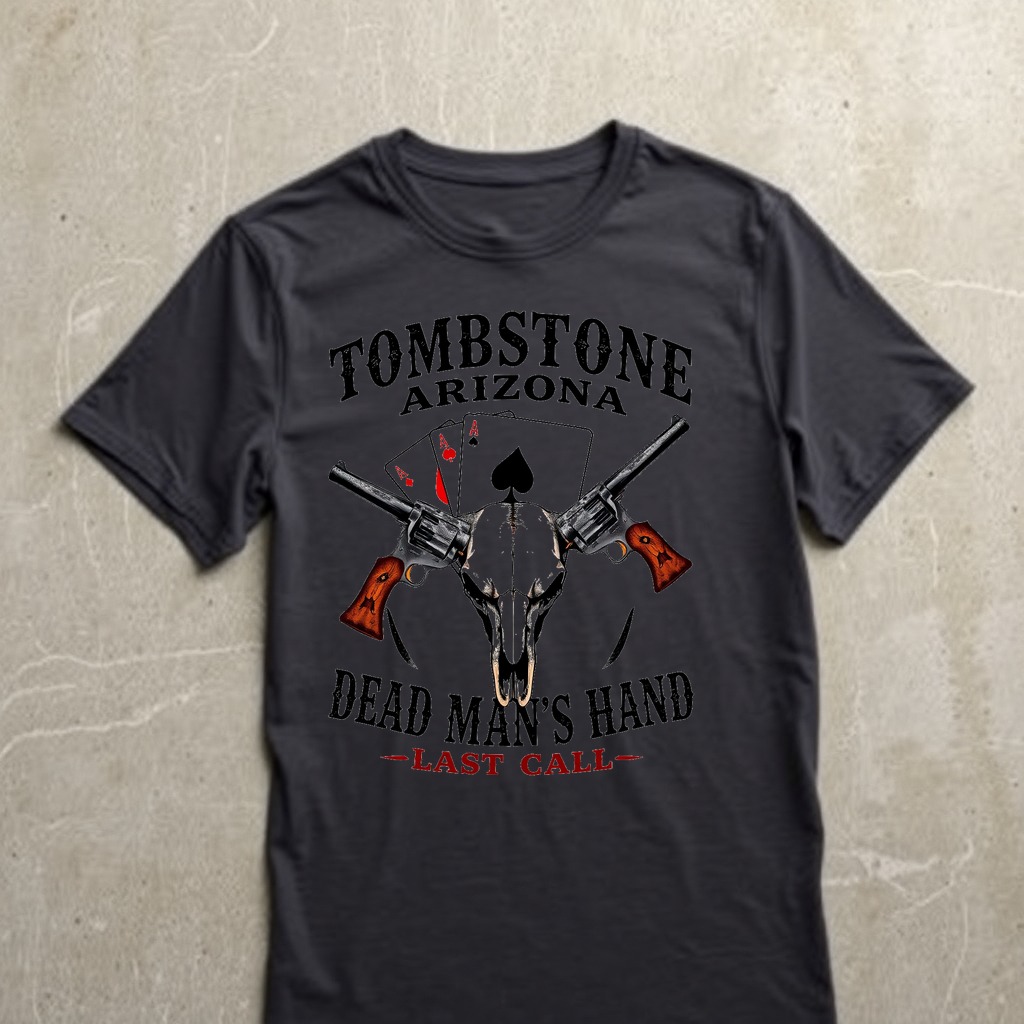
The image of black aces, black eights, crossed revolvers, and weathered cow skulls became the ultimate emblem of high-stakes American fatalism: the recognition that while no man outruns his fate, an outlaw faces destiny on his own terms with stoic dignity.
Today, that ethos resonates not with outlaw violence, but with a deep longing for the untamed American spirit: desert road trips down two-lane highways, midnight campfires in the high desert of West Texas, and an absolute refusal to conform to sterile, sanitized modern living. For more on high desert legends, explore our field guide to Western Americana Folklore & Desert Ghost Towns.
3. Rust & Roam’s Western Revival Collection
At Rust & Roam Co., our Austin design studio pays homage to 19th-century frontier typography, hand-tooled leather saddle aesthetics, and dusty saloon lore. Explore four standout customer favorites from our Western Revival & Outlaw Collection:
Tombstone Dead Man’s Hand Outlaw Tee
Vintage Wash CC 1717 • $34.00
Featuring the legendary aces and eights poker hand, crossed frontier steel, and desert motifs.
Old Iron 1969 Vintage Truck Tee
Garment-Dyed Cotton • $34.00
Dedicated to carbureted farm trucks, Western ranch gates, and decades of patina.
Speed Shop Motorcycle Heritage Tee
Heavyweight Ring-Spun • $34.00
Honoring independent desert wrenching, open throttle exhausts, and highway freedom.
Full Tank Gas & Oil Globe Tee
Vintage Wash CC 1717 • $34.00
Mid-century neon service stations, rusted desert pumps, and two-lane American lore.
4. The Fabric of the Frontier: Heavyweight 6.1 oz Ring-Spun Cotton
You cannot tell a story of frontier endurance on a thin, 3.8 oz polyester blend that feels like tissue paper. Fast-fashion graphic tees stick to sweaty skin, fade into muddy grays after two wash cycles, and develop frayed rib collars within months.
Every shirt we produce is printed exclusively on genuine Comfort Colors 1717 blanks:
- 6.1 oz Dense Ring-Spun Weave: Heavyweight cotton provides natural insulation against desert wind and evening chills while maintaining full breathability.
- Garment-Dyed Pigment Washing: The rich Pepper Black, Terracotta, and Espresso tones are washed into the constructed shirt, giving each piece the sun-baked patina of a vintage desert relic.
- Tubular Seamless Body: Knit in a continuous tube with zero side seams, preventing diagonal twisting when washed. For complete sizing specifications, visit our Comfort Colors 1717 Sizing & Review Guide.
5. Frequently Asked Questions About the Dead Man’s Hand
What happened to the assassin Jack McCall?
Immediately following the shooting, McCall was tried by an informal miner’s jury in Deadwood and acquitted after claiming Hickok had previously killed his brother. However, because Deadwood was unorganized territory on Lakota land, federal authorities did not recognize the verdict. McCall was rearrested, tried in the US District Court at Yankton, convicted of murder, and executed by hanging on March 1, 1877.
Why is the Dead Man’s Hand associated with Tombstone if Hickok was killed in Deadwood?
While Hickok was slain in the Black Hills of South Dakota, the culture of frontier gambling, saloon codes, and fatalistic gunfights reached its peak in silver-rush towns like Tombstone, Arizona just five years later in 1881. The term became a universal shorthand across the American Southwest for frontier fate and dangerous card rooms.
How should I wash garment-dyed Western graphic tees to preserve the design?
Always turn the shirt inside out before washing in cold water (under 85°F / 30°C) with mild detergent. Avoid bleach and high-heat dryer cycles. Our water-based inks sink directly into the cotton weave, developing a gorgeous vintage fade without peeling. Read our full Field Guide to Washing Garment-Dyed Tees.
Claim Your Frontier Legacy
Explore our curated collection of vintage Western and desert outlaw graphic tees crafted on 6.1 oz Comfort Colors 1717 blanks.
Written by The Rust & Roam Editorial Team
Born out of dusty backroads, early dawn river casts, and crackling pine embers. We obsess over heavyweight Americana blanks, breathable water-based inks, and timeless heritage gear that wears in, not out.