
If you grew up anywhere near a county fairground, a dirt farm road, or a sunbaked Texas ranch in the late 1970s, the visual geometry of your childhood was drawn in straight, unyielding lines. No swooping plastic aerodynamics. No computer-monitored touchscreens. Just a stamped-steel cowl, dual rectangular sealed-beam headlamps, a bench seat wide enough for three adults and a bird dog, and an unkillable cast-iron small-block V8 rumbling through twin glasspacks.
Officially christened the “Rounded Line” generation by General Motors upon its debut in late 1972 for the 1973 model year, the truck world quickly tossed aside the corporate marketing brochures and coined its own moniker: the Squarebody. Spanning an astonishing 15-year production run until 1987 (and through 1991 for Suburbans, Blazers, and crew cabs), the third-generation Chevrolet C/K and GMC Sierra wasn’t just a commercial vehicle. It became the backbone of working-class American mobility.
The Squarebody Era at a Glance (1973–1987)
During its 15-year factory reign, GM produced over 10 million Squarebody trucks at plants in Flint, St. Louis, Janesville, and Oshawa. Designed using early computer-aided wind tunnel testing yet defined by sharp 90-degree creases, it was the first mass-production pickup to combine genuine one-ton payload capacity with civilized daily ergonomics.
1. Stamped Steel & Cast Iron: The Anatomy of an Unbreakable Rig
What elevates the Squarebody above almost every other generation of domestic utility trucks is its relentless overbuilding. Look underneath a 1978 K10 half-ton or a K20 three-quarter-ton 4×4. There are no flimsy stamped aluminum control arms or electric steering racks. You find a massive ladder-frame chassis with carbon-steel channel rails, leaf springs at all four corners, and a solid front Dana 44 or GM 10-bolt axle matched to a corporate 12-bolt or bulletproof 14-bolt full-floater in the rear.
Then came the transfer cases. Squarebody four-wheel drives from the mid-to-late 1970s frequently housed the legendary New Process Gear NP205—a 138-pound behemoth of cast-iron casing and helical-cut spur gears that didn’t know how to strip or fail. Whether you were pulling a horse trailer out of axle-deep spring mud or creeping across slickrock shelves in Moab, when you shoved the floor shifter into 4-Low, the mechanical linkage locked mechanically into place with a visceral thunk that modern pushbutton dials can never replicate.
Legendary Squarebody Powertrains
| Engine Option | Displacement | Peak Torque | Historical Reputation |
|---|---|---|---|
| Inline-6 250 / 292 | 4.1L / 4.8L | 250 lb-ft @ 1600 RPM | Torquey farm workhorse; virtually impossible to kill. |
| Small-Block 350 V8 | 5.7L | 275 lb-ft @ 2400 RPM | The undisputed king of American crate engines; omnipresent parts. |
| Small-Block 400 V8 | 6.6L | 290 lb-ft @ 2000 RPM | Siamesed cylinders with low-end pulling grunt for heavy haulers. |
| Big-Block 454 V8 | 7.4L | 385 lb-ft @ 1600 RPM | The big gun of camper-specials and three-quarter-ton tow rigs. |
2. The Tailgate Culture: Why the Squarebody Refuses to Die
Today, you see third-generation GM trucks at high-end SEMA exhibitions, vintage drag strips, and backwoods hunting camps in equal measure. Why? Because the Squarebody represents the exact inflection point in American automotive history where utility and aesthetic purity reached perfect equilibrium.
Every line on the body had a purpose. The subtle indentation running down the center of the hood reduced headlight glare on lonely two-lane highways. The squared wheel wells accommodated 33-inch mud-terrain tires on a modest 4-inch suspension lift without requiring aggressive fender trimming. And the tailgate was simple stamped iron—heavy enough to sit three grown men on while cracking cold cans around an open campsite fire.
Unlike modern pickups equipped with thousands of microscopic electronic microcontrollers that brick themselves over software updates, a Squarebody can be kept running in perpetuity with a flathead screwdriver, a timing light, a set of 9/16 wrenches, and a fresh roll of safety wire. You don’t need a certified dealership diagnostic scanner to troubleshoot an HEI distributor or clear a stubborn float needle in a Rochester Quadrajet carburetor.
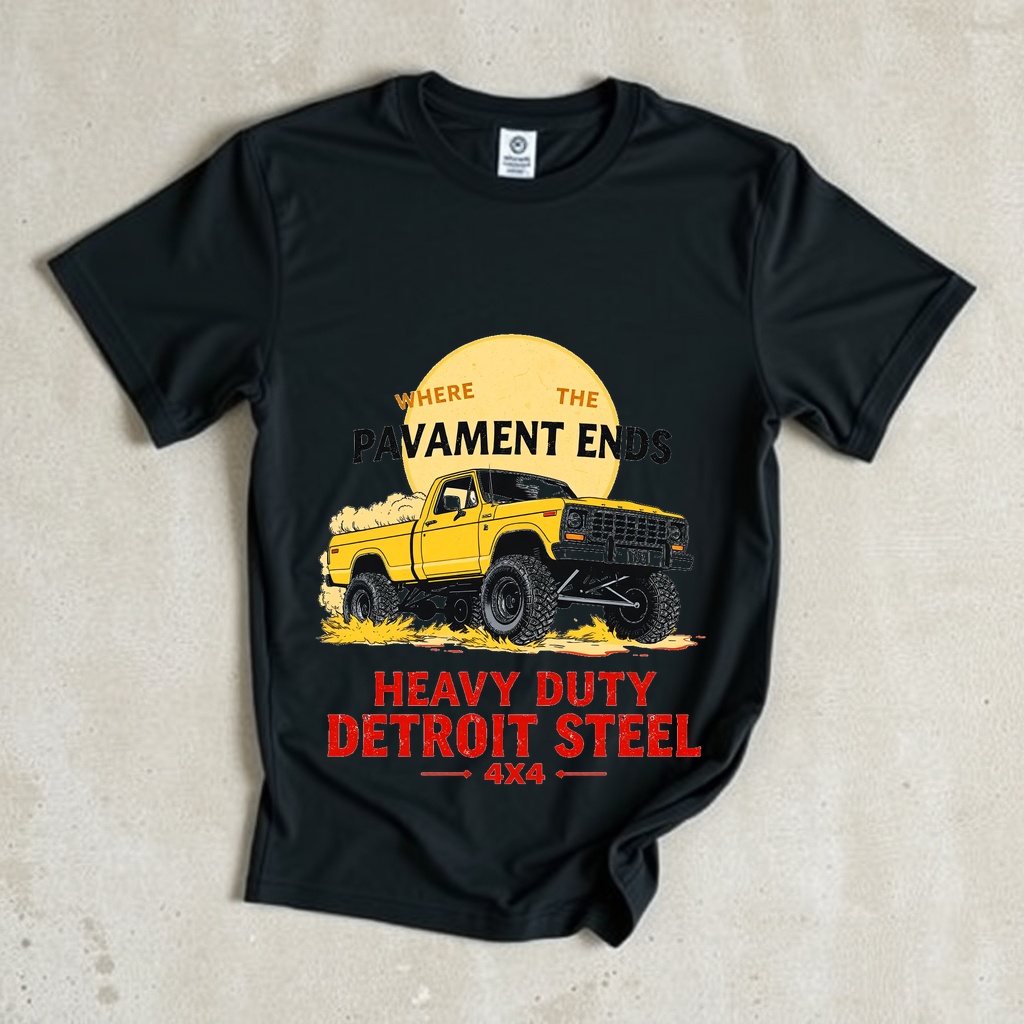
1978 Squarebody 4×4 Desert Runner Tee
Our hand-drawn tribute to the lifted, two-tone workhorses that tamed the desert washes of the American Southwest. Screen printed in Austin, Texas on heavyweight 6.1 oz Comfort Colors 1717 garment-dyed cotton that feels like it’s survived thirty years in the back of a toolbed.
3. Building the Ultimate Overland & Desert Pre-Runner Rig
Over the past decade, a quiet renaissance has taken place in the off-road overland community. Overlanding used to be dominated exclusively by imported Toyota Land Cruisers and European Defenders. But seasoned backcountry travelers quickly rediscovered the undeniable math of vintage American iron:
-
•
Every Small-Town Auto Parts Store Has Parts: Break an alternator belt or snap a U-joint outside a two-pump gas station in Wyoming? Any rural Napa or O’Reilly has a GM 350 water pump or 1310 U-joint sitting on the bottom shelf for under thirty dollars.
-
•
Unrivaled Bed Capacity: A long-bed 8-foot Squarebody easily swallows a slide-in camper, two spares, forty gallons of auxiliary fuel, and a heavy iron Dutch oven setup without squatting the rear axle into the bumpstops.
-
•
Immunity to Trail Scratches: When you scrape a sixty-thousand-dollar electronic crossover against desert mesquite or pinon pines, your heart sinks. When you brush a weathered two-tone 1979 Scottsdale against cedar brush, it simply adds another layer of character to the patina.
4. The Fabric of the Garage: Why Heavyweight Cotton Belongs in the Cab
There is a profound philosophical parallel between a vintage Squarebody and a 6.1 oz ring-spun cotton tee. Neither was built for superficial fragility. In the 1970s, workwear was expected to absorb sweat, resist grease splatters, survive snagged barbed wire, and soften with every wash cycle without unraveling at the seams.
When you’re wrenching under the oil pan or driving with the vent windows propped open across west Texas state highways, lightweight synthetic polyester shirts cling, melt near hot headers, and stink of artificial petrochemicals. True heavyweight 100% garment-dyed cotton breathes naturally in the desert sun and insulates when the mountain temperature drops at midnight. If you respect the machines built by American hands half a century ago, you dress in gear built with the same uncompromising honesty.
Explore the Garage & Motor Collection
Hand-printed vintage automotive, 4×4, and speed shop graphic tees on legendary Comfort Colors 1717 blanks.
Written by The Rust & Roam Editorial Team
Born out of dusty backroads, early dawn river casts, and crackling pine embers. We obsess over heavyweight Americana blanks, breathable water-based inks, and timeless heritage gear that wears in, not out.