
In a world where 80 percent of the global population and 99 percent of Americans live under skies polluted by artificial LED glow, there exists a vast, forgotten corner of southeastern Oregon where true primal darkness still reigns supreme. Covering an astonishing 2.5 million acres of public sagebrush basins, fault-block scarps, and dry lakebeds, the Oregon Outback Dark Sky Sanctuary has been officially certified as the single largest dark sky reserve on planet Earth.
Designated by DarkSky International across Lake County, Oregon, this sanctuary protects an area nearly the size of Yellowstone National Park from artificial light pollution. Under its unpolluted celestial dome, the Milky Way doesn’t appear as a faint smudge; it casts distinct, observable shadows across the desert playa, while the Andromeda Galaxy (M31) blazes brightly to the naked human eye from 2.5 million light-years away.
Bortle Class 1: The Gold Standard of Cosmic Darkness
Astronomers measure night sky brightness on the 9-point Bortle Scale. Class 9 represents inner-city nightscapes like New York or Las Vegas where only the moon and brightest planets are visible. The Oregon Outback registers at a pristine Bortle Class 1: zero detectable artificial sky glow, zodiacal light clearly visible in autumn, airglow illuminating the horizon with natural faint green luminescence, and thousands of stars visible across every square degree of sky.
1. Top Stargazing Corridors in the Oregon Outback
Southeastern Oregon is rugged, remote, and sparsely populated, requiring self-sufficiency and high-clearance tires:
-
01.
Hart Mountain National Antelope Refuge: Perched atop a massive fault block ridge rising 3,000 feet above the Warner Valley, campers soak in natural outdoor hot springs while the summer galactic core of the Milky Way arches directly overhead between prongs of distant ridge horns.
-
02.
Summer Lake & Fort Rock Basin: Wide-open ancient pluvial lakebeds framed by towering volcanic tuff rings. The flat horizon provides unobstructed 360-degree celestial viewing from dusk until dawn, ideal for wide-angle astrophotography tracking meteor showers.
-
03.
Abert Rim: One of the longest and highest exposed fault scarps in the United States, stretching thirty continuous miles. Standing at the rim at midnight feels like standing at the very edge of the continent looking straight into deep space.
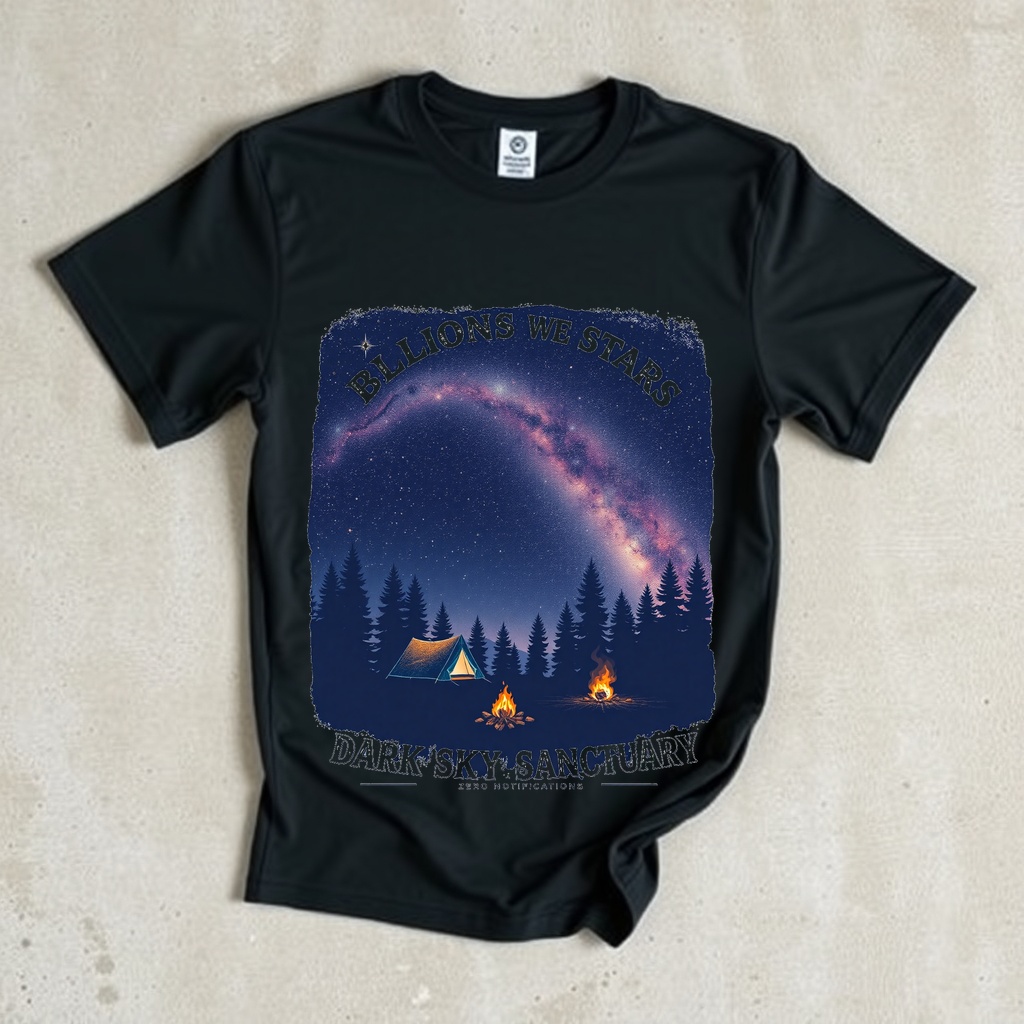
Milky Way Over Campfire Dark Sky Tee
Our typographic tribute to Class 1 dark sky preserves, night-adapted red headlamps, and midnight campfires under the cosmos. Screen-printed in Austin, Texas on heavyweight 6.1 oz Comfort Colors 1717 garment-dyed cotton.
2. Night Campcraft: Preserving Your Scotopic Night Vision
The human eye requires 30 to 45 minutes of absolute darkness for rhodopsin (visual purple) to accumulate in retinal rod cells, granting true scotopic night vision. A single 2-second flash from a white LED flashlight or smartphone screen bleaches rhodopsin immediately, destroying your night vision for another half hour.
Follow these three dark sky campcraft commandments:
- • Red Light Only: Use red-spectrum headlamps or cover lantern globes with red cellophane; deep red light (>650nm) does not trigger rhodopsin breakdown.
- • Keep Campfires Low: As the astronomy session begins, let your campfire burn down to glowing embers to eliminate blinding ambient flare.
- • Analog Star Charts: Ditch digital phone apps and navigate constellations with an analog cardboard planisphere star wheel.
3. Sub-Freezing Midnight Air & Heavyweight Cotton Warmth
Even in mid-summer, high-desert basins at 5,000 feet radiate heat rapidly into cloudless skies, dropping temperatures into the 30s by 2:00 AM. Stargazing is a sedentary activity—you aren’t hiking to generate body heat.
Pulling on a 6.1 oz heavyweight ring-spun cotton tee beneath a thick wool flannel or shearling jacket provides the perfect foundational warmth. Soft, thick, and breathable, Comfort Colors 1717 cotton keeps you warm around the embers as you watch the Perseids streak across the cosmos.
Gaze Into the Infinite
Use code ROAM10 at checkout to save 10% on your first order of night sky and celestial wilderness graphic tees.
Written by The Rust & Roam Editorial Team
Born out of dusty backroads, early dawn river casts, and crackling pine embers. We obsess over heavyweight Americana blanks, breathable water-based inks, and timeless heritage gear that wears in, not out.