
Few geographic transitions in North America shock the human senses quite like descending into the Colorado Plateau of Southern Utah: endless rolling sagebrush flats abruptly fracture into violent 2,000-foot sheer vertical ramparts of cross-bedded Navajo sandstone, bleeding shades of burnt terracotta, vermilion, iron rust, and creamy peach into a cloudless turquoise sky.
Separated by just 75 scenic miles along Utah’s Highway 9 and Scenic Byway 12, Zion National Park and Bryce Canyon National Park form the dramatic lower steps of the Grand Staircase—a geological chronicle spanning hundreds of millions of years of ancient inland seas, towering Jurassic sand dunes, and relentless freeze-thaw erosion. To hike these canyons is to confront deep planetary time on foot.
The Grand Staircase Geology: Zion vs. Bryce
Geologically, Bryce Canyon sits approximately 4,000 feet higher in elevation than the bottom of Zion Canyon. The rock layers at the very top of Zion’s staggering monoliths (such as The Great White Throne) form the bottom bedrock basement at Bryce Canyon. While Zion is carved by the hydraulic velocity of the Virgin River cutting down into sandstone, Bryce is sculpted by frost wedging shattering limestone into delicate, spire-like hoodoos.
1. Zion Canyon: Walking Among Giants in the Sunken Temple
Entering Zion from the Springdale portal feels like driving into a hollowed cathedral. The scale is disorienting; the canyon floor is narrow, lush with box elder and cottonwood trees, framed on both sides by titanic monoliths—The Watchman, The Court of the Patriarchs, and Mount Majestic.
The Narrows: Wading the Subterranean Slot
No trail on earth compares to The Narrows. There is no dirt footpath; the river is the trail. Wading upstream through the cold, silt-laden waters of the Virgin River beneath thousand-foot weeping walls that narrow to just twenty feet across (The Wall Street section) is a sacred sensory overload. Sunlight filters down in ambient, golden shafts, bouncing off turquoise pools and water-worn cobbles.
Angels Landing & Walter’s Wiggles
Climbing 1,500 vertical feet to the spine of Angels Landing requires nerves of cold iron. After grinding up the 21 tight switchbacks of Walter’s Wiggles, hikers grip heavy chain handrails bolted directly into the knife-edge sandstone fin, with 1,000-foot sheer drop-offs plunging straight down into the canyon floor on either side. At the summit, the 360-degree panorama of Zion Canyon stretches out like an ancient kingdom frozen in stone.
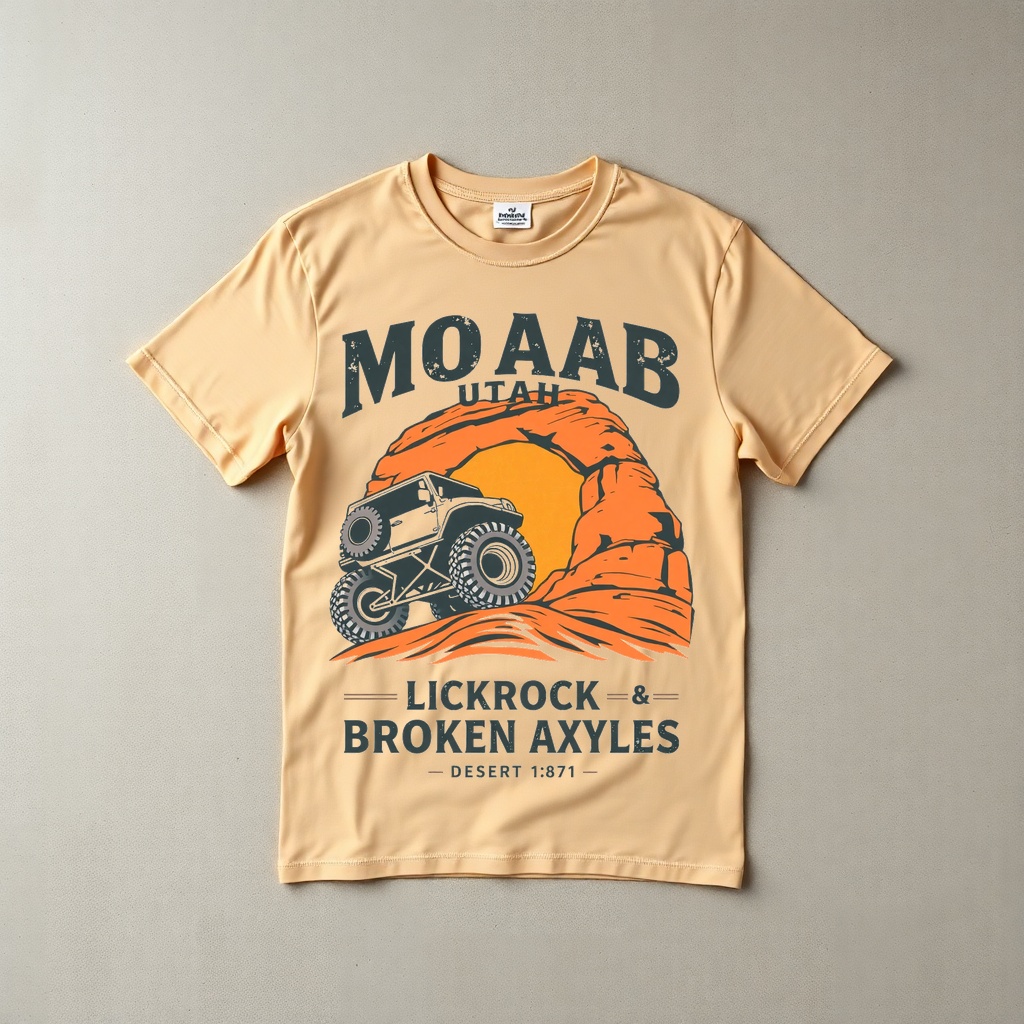
Moab Utah Slickrock Crawler Tee
Inspired by the high-traction sandstone slickrock, red dirt trails, and rugged 4×4 climbs of Southern Utah. Hand-printed on 6.1 oz heavyweight Comfort Colors 1717 garment-dyed cotton that mirrors the earthy rust and terracotta tones of the American Southwest.
2. Bryce Canyon: The Silent Forest of Stone Hoodoos
Bryce Canyon is not actually a canyon; it is a series of massive natural amphitheaters carved into the eastern edge of the Paunsaugunt Plateau at over 8,000 feet above sea level.
Standing at Sunrise Point when the first rays of morning dawn hit the amphitheater is an otherworldly experience. Millions of fairy chimneys, fin walls, and spires known as hoodoos ignite in vibrant shades of incandescent orange, chalky white, and blood red. The Navajo legend of the Paiute people holds that the hoodoos are the “Legend People” (To-when-an-ung-wa), turned to stone by the trickster Coyote for their greed.
Hiking the Queens Garden / Navajo Loop Combination takes you directly into the belly of the maze. Descending through the narrow, shaded slot of “Wall Street” beneath towering Douglas fir trees that reach toward the narrow opening above, you experience the peculiar silence of high-elevation desert amphitheaters—a cathedral hush broken only by the crunch of crushed limestone beneath your boots.
High-Desert Survival & Flash Flood Discipline
The high desert of Utah is as unforgiving as it is magnificent. Two immutable rules dictate backcountry survival:
1. Flash Floods in Slot Canyons: In a slot canyon like The Narrows or Subway, a summer thunderstorm twenty miles upstream can turn a peaceful ankle-deep brook into a twelve-foot wall of muddy water, boulders, and tree trunks within minutes. Always check the NOAA flash flood forecast at the visitor center before setting foot in the river.
2. The One-Gallon Hydration Rule: With relative humidity frequently dropping below 10% and elevations surpassing 8,000 feet, you will lose moisture rapidly through respiration without realizing it. Carry one gallon (4 liters) of water per person per day, paired with sodium electrolytes.
3. Earth Pigments & The Southwest Palette: Colors Born from Stone
The iconic visual aesthetic of the American Southwest has captivated artists, photographers, and gear designers for generations. It is an honest palette defined by elemental minerals:
- • Iron Oxide Rust & Terracotta: Leached from ancient hematite and limonite grains embedded within the Navajo and Wingate sandstone formations.
- • Desert Ochre & Sand: Reflecting the midday glare across wind-sculpted slickrock domes and dry arroyos.
- • Pinon Pine & Desert Sage: The dusty olive-gray greens of hearty flora clinging stubbornly to cracked stone ledges.
4. The 40°F Swing: Why Heavyweight Breathable Cotton Rules the Desert
A common rookie mistake when visiting Southern Utah is assuming the desert is always blazing hot. In reality, the high elevation causes dramatic 40-degree temperature swings: a crisp 42°F at dawn at Bryce Rim can transform into an 85°F scorching afternoon on the canyon floor.
Synthetic activewear traps odor and feels clammy against sunburned skin when the wind picks up. In contrast, 100% ring-spun 6.1 oz heavyweight cotton acts as natural thermodynamic armor: it breathes freely during strenuous switchback climbs, protects shoulders from harsh UV radiation and abrasive sandstone scrapes, and retains just enough ambient warmth when desert twilight descends and the stars begin to blaze across the dark sky.
Answer the Call of the Red Rocks
Explore our complete collection of Utah slickrock crawler, 4×4 overland, and National Park heritage graphic tees.
Written by The Rust & Roam Editorial Team
Born out of dusty backroads, early dawn river casts, and crackling pine embers. We obsess over heavyweight Americana blanks, breathable water-based inks, and timeless heritage gear that wears in, not out.