
At the Mexican border monument near Campo, California, a weathered wooden monument marks the southern terminus of the Pacific Crest Trail. Ahead lies 2,650 miles of unbroken wilderness: 700 miles of baking desert washes and chaparral hills, 400 miles of granite alpine passes above 10,000 feet in the High Sierra, the volcanic basalt ridges of the Cascades, and the rain-soaked temperate rainforests of northern Washington terminating at the Canadian boundary at Monument 78.
Thru-hiking the PCT is not a vacation; it is a five-month pilgrimage of sheer physiological and psychological endurance. You will burn upwards of 5,500 calories each day, destroy three to four pairs of trail runners, dry out under 105-degree desert gusts, and wake up with your water bottles frozen solid inside your tent on Forester Pass. Here is what every aspiring long-distance hiker must understand about the trail that defines Western American backpacking.
The Pacific Crest Trail: Key Vital Statistics
Total Distance: 2,650 Miles (4,265 km) • Elevation Gain: 420,880 feet (equivalent to climbing Everest 14 times) • Highest Point: Forester Pass (13,153 ft / 4,009 m) • Ecosystems Crossed: 7 distinct biomes spanning 25 National Forests and 7 National Parks.
1. The Five Distinct Acts of the Pacific Crest Trail
The PCT is unique among the world’s great long-distance footpaths because it transforms dramatically every 500 miles. Understanding the rhythm of these five distinct sections is essential for pacing and gear survival:
Act I: Southern California Desert (Miles 0 – 702)
Starting in late April, hikers must conquer 20-to-30-mile waterless stretches under brutal spring radiation. Water management is everything: carrying six to eight liters through the San Felipe Hills, tracking reliable trail angel caches, and hiking during moonlight hours to avoid heat exhaustion.
Act II: The High Sierra (Miles 702 – 1,018)
Entering Kennedy Meadows South, the desert dust gives way to towering lodgepole pines, crystal-clear snowmelt cascades, and jagged granite ramparts. Hikers strap bear canisters and microspikes to their packs to navigate treacherous passes—Forester, Glen, Pinchot, Mather, Muir—where early summer snowpack and freezing river fords test footwork and judgment.
Act III: Northern California (Miles 1,018 – 1,692)
Often dubbed the “mid-trail mental wall,” NorCal features long, undulating green ridges, high heat through the Shasta-Trinity wilderness, and the official halfway marker at Chester. The physical conditioning is now locked in, but mental resilience becomes the primary battleground.
Act IV: Oregon (Miles 1,692 – 2,147)
Relatively flatter terrain through lodgepole pine corridors and volcanic fields past Mount Hood, Mount Jefferson, and Crater Lake. This is where hikers sprint 30-to-35-mile days to make up time before the early autumn snowstorms strike the North Cascades.
Act V: Washington & The North Cascades (Miles 2,147 – 2,650)
Crossing the Bridge of the Gods into Washington, the trail delivers its most breathtaking and demanding topography: Glacier Peak wilderness, knife-edge alpine traverses, relentless vertical switchbacks, and the threat of September blizzards. Touching the wooden monument at Monument 78 is a moment of pure existential quiet.
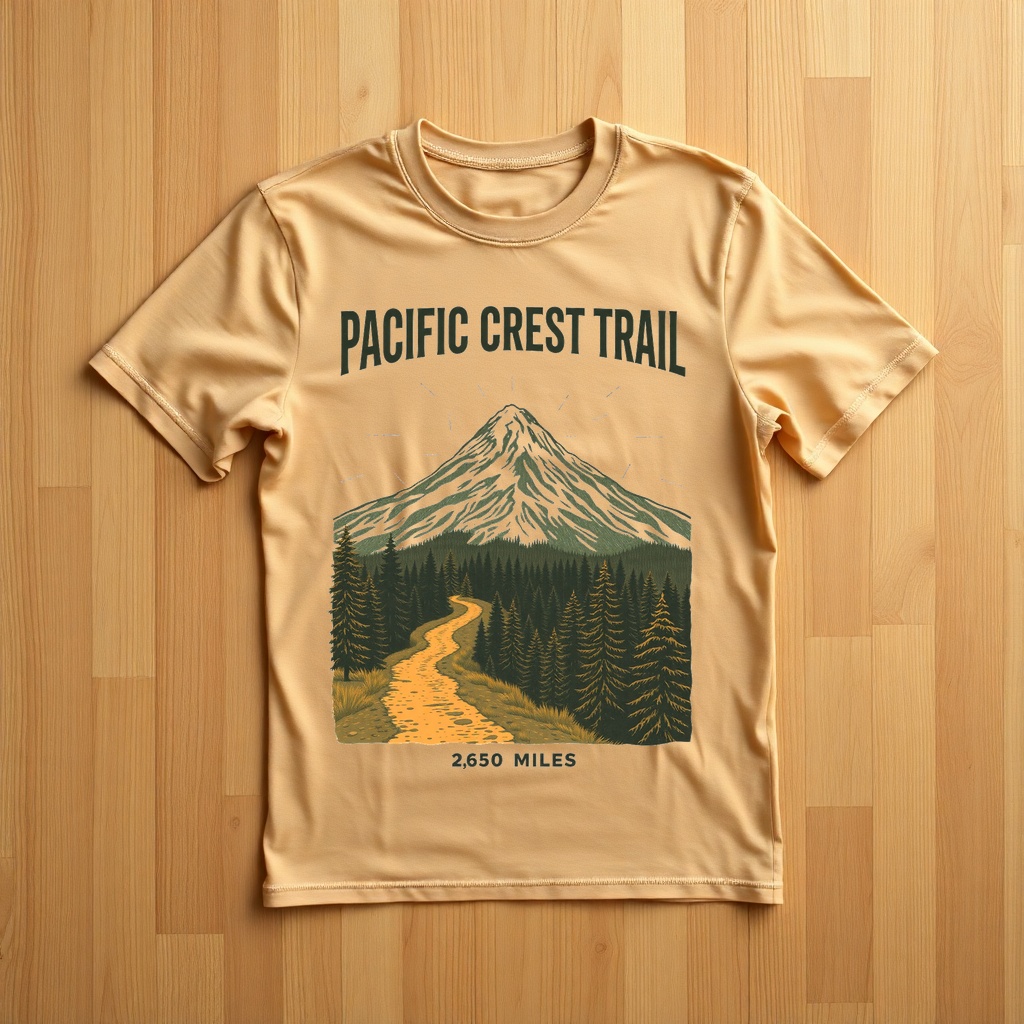
Pacific Crest Trail Hiking Heritage Tee
Featuring an authentic hand-drawn typographic shield celebrating the 2,650 miles from Mexico to Canada. Printed in Texas on 6.1 oz garment-dyed Comfort Colors 1717 cotton that softens with every trail town wash without losing its rugged vintage weight.
2. Essential Campcraft: Surviving the High Sierra & Desert
To complete a thru-hike, you cannot pack your fears. Modern ultralight philosophy teaches that every additional ounce carried over 2,650 miles represents millions of foot-pounds of wasted energy. But true backcountry resilience requires balancing light pack weight with uncompromising durability:
-
•
Water Filtration Redundancy: Desert cattle ponds in Southern California can be thick with algae and bovine runoff. Always pair a hollow-fiber squeeze filter (Sawyer Squeeze or Platypus QuickDraw) with chlorine dioxide chemical drops as a backup. Never rely on a single filter in the desert.
-
•
The Zero-Degree Sleep System: Do not compromise on your sleep system in the Sierra. A certified 10-degree or 20-degree down quilt paired with an insulated sleeping pad (R-value of 4.5+) keeps you in restorative deep sleep when valley winds whistle across 11,000-foot benches.
-
•
Trail Town Protocol: When you hit resupply towns like Idyllwild, Bishop, Mammoth Lakes, or Cascade Locks, wash your clothes thoroughly, eat calorie-dense meals with fresh greens, inspect your feet for hot spots, and respect the local trail communities who keep the trail culture alive.
Built for the Long Trail
Explore our complete collection of National Parks, Appalachian Trail, and Pacific Crest Trail vintage graphic tees.
Written by The Rust & Roam Editorial Team
Born out of dusty backroads, early dawn river casts, and crackling pine embers. We obsess over heavyweight Americana blanks, breathable water-based inks, and timeless heritage gear that wears in, not out.